tech · 2025-07-10
US Probe Targets H-1B Use by Indian IT
57a5a77c-ef11-49e4-b45b-be5fb6b8dfe3
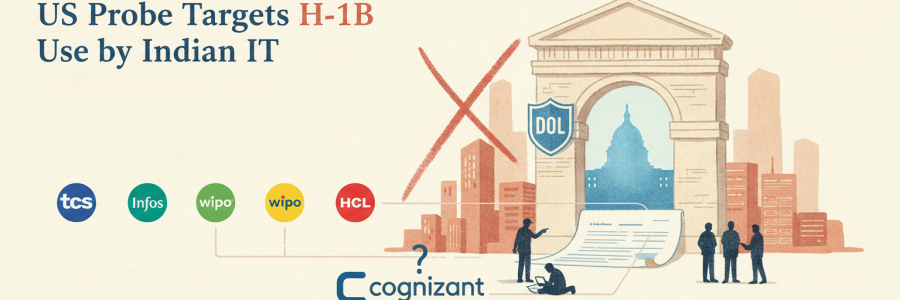
US Dept of Labor is probing alleged H-1B visa and green card fraud, with Cognizant named in the investigation.Indian IT firms earn most revenue from the US. A crackdown could force costly changes to how they staff American projects.TCS, Infosys, Wipro, and HCL face uncertainty, as it is unclear whether the probe extends beyond Cognizant.
What exactly triggered this DOL probe?
Whistleblowers reportedly triggered the DOL investigation, alleging H-1B visa and green card fraud. The probe focuses on whether companies misrepresented job roles or wages when sponsoring foreign workers. Cognizant is the only firm publicly named so far, but the scope may widen.
How do whistleblower complaints reach DOL?
Workers or competitors can file complaints directly with DOL's Wage and Hour Division or its Office of Inspector General. Tips can be anonymous. DOL then decides whether evidence warrants a formal audit. In 2020, DOL received over 1,200 H-1B related complaints, roughly 3 per day.
What specific fraud types does the probe allege?
Common allegations include paying H-1B workers below the prevailing wage for a role, misclassifying job levels to lower salary requirements, or filing for positions that don't genuinely exist. For example, listing a senior engineer role as entry-level lets a company legally pay $30K less per year.
Has DOL acted against IT firms before?
Yes. In 2013, Infosys paid $34Mn to settle allegations it used B-1 visitor visas instead of H-1B work visas to place engineers in the US. That remains one of the largest immigration-related settlements by an IT firm and prompted industry-wide compliance overhauls.
Could this reshape how IT firms staff US work?
Indian IT firms like TCS and Infosys derive 50-60% of revenue from North America. If the DOL tightens enforcement, firms may need to hire more locally in the US at higher salaries. Cognizant previously paid $95Mn to settle a separate discrimination lawsuit in 2021, showing how costly compliance failures become.
How much do US operations drive Indian IT revenue?
TCS earns ~54% of revenue from North America. Infosys gets ~62%. Wipro is at ~61%. For context, TCS's total FY25 revenue was ~$29Bn, meaning roughly $15.7Bn depends on US operations. Any disruption to how staff are deployed there hits the single largest revenue pool.
What does local hiring in the US cost vs H-1B?
An H-1B engineer in the US might cost a firm $80K-100K annually. A locally hired US engineer for the same role typically commands $120K-150K. That 40-50% gap is a core part of the offshore-onshore arbitrage model. Cognizant and peers already increased US local hiring to ~50% of US headcount to reduce visa dependence.
Could clients shift work to avoid visa risk?
Yes, clients could accelerate offshoring, moving more work to India-based delivery centers to sidestep onsite visa complications. Accenture and Deloitte, which rely less on H-1B visas, could also win share. During the 2020 H-1B lottery tightening, some banking clients shifted analytics work to Bangalore and Hyderabad centers.
Which firms beyond Cognizant are exposed?
Beyond Cognizant, TCS, Infosys, Wipro, and HCL all rely heavily on H-1B visas to rotate engineers into US client sites. ET sent queries to all five firms. None confirmed involvement, but all use similar staffing models, making them structurally vulnerable to the same scrutiny.
Do all Indian IT firms use the same visa model?
No. Business models vary. TCS and Infosys have shifted toward higher-value consulting with more local US hires. Cognizant historically placed a higher proportion of H-1B workers onsite. HCL's infrastructure services model uses fewer visa-dependent roles. The mix determines each firm's regulatory exposure differently.
How are mid-tier IT firms like LTIMindtree hit?
Mid-tier firms like LTIMindtree and Mphasis derive 75-80% of revenue from North America, often higher than top-tier peers. They also have smaller compliance teams. LTIMindtree, with ~$4.5Bn revenue, has less buffer to absorb sudden staffing cost increases than TCS at $29Bn.
Could this accelerate AI-driven automation?
Firms may accelerate using AI tools to reduce the number of engineers needed onsite. Infosys's AI platform Topaz already automates code testing and migration tasks that previously required onsite presence. If each AI tool replaces even 2-3 onsite roles per project, visa dependence drops structurally, not just through local hiring.
Source: economictimes.indiatimes.com