tech · 2026-07-02
Vande Bharat Sleeper Reaches Bengaluru
b4c69584-98b3-4817-8adb-796709a07071
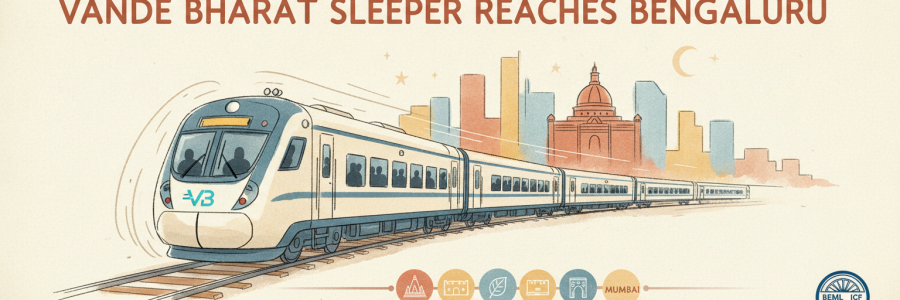
India's second Vande Bharat Sleeper train, built by BEML, has reached Bengaluru for final testing before its launch on the Bengaluru-Mumbai route.The first sleeper cut Howrah-Kamakhya travel time by 6 hours. This route connects 5 major cities including Pune, Belagavi, and Hubballi-Dharwad.823 passengers per trip gain a semi-high-speed overnight option. BEML, ICF Chennai, and South Western Railway zone handle production and operations.
What makes this sleeper train different?
The 16-coach train carries 823 passengers across three classes: 611 in 3-Tier, 188 in 2-Tier, and 24 in First AC. It features Kavach safety technology, automatic doors, and a design speed of 180 kmph. Unlike regular sleepers, it uses superior suspension and noise reduction for semi-high-speed overnight travel.
How does Kavach work on this train?
Kavach is an automatic train protection system that applies emergency brakes if a driver misses a red signal. It uses GPS, radio communication, and trackside equipment. Indian Railways has deployed Kavach on ~1,500 km of track so far, with plans to cover the entire network. On the sleeper, it adds a collision-avoidance layer to overnight runs when visibility drops.
What's different about its berth design?
The berths use ergonomic design with improved cushioning compared to standard ICF sleeper coaches. Traditional Indian sleeper berths are flat vinyl surfaces with thin padding. The Vande Bharat Sleeper adds contoured cushions and noise-reducing panels. For context, Rajdhani Express coaches, the previous premium sleeper standard, use older LHB-platform berth designs.
Why a 180 kmph design speed if tracks lag?
Indian tracks currently allow ~130 kmph on the best sections. Designing for 180 kmph future-proofs the rolling stock. Upgrading track is cheaper than replacing trains. The Delhi-Mumbai corridor is being upgraded for 160 kmph under the Mission Raftaar plan. Once track speed rises, these trainsets can run faster without new procurement, unlike older coaches capped at 110 kmph.
Could this route change how people travel?
The Bengaluru-Mumbai corridor is one of India's busiest intercity routes. Flights take ~1.5 hours but involve airport transit. The first Vande Bharat Sleeper cut Howrah-Kamakhya time by 6 hours. If similar gains apply here, overnight rail becomes competitive with flights, especially for the Hubballi-Dharwad and Belagavi stops that lack direct air links.
How much time could this save vs flights?
The Bengaluru-Mumbai flight is ~1.5 hours, but door-to-door including airport transit often exceeds 4 hours. If the sleeper departs at night and arrives by morning in ~12 hours, passengers save a hotel night. For a Bengaluru IT professional, the total cost of flight plus hotel can exceed ₹8K. A 2-Tier sleeper berth would likely cost ₹2K to ₹3K.
Does the Hubballi stop change the calculus?
Hubballi-Dharwad, with ~1.2Mn population, is Karnataka's second-largest urban agglomeration but has limited air connectivity. The nearest airport handles few daily flights to Mumbai. A direct semi-high-speed sleeper stop transforms it into a 1-seat ride to Mumbai. Belagavi, near the Maharashtra border, similarly benefits, connecting Karnataka's northern belt to both terminus cities.
What if demand exceeds 823 seats per trip?
Indian Railways typically gauges demand over 3 to 6 months, then adds frequency. The Howrah-Kamakhya Vande Bharat Sleeper launched in Jan 2026 as a single service. If Bengaluru-Mumbai occupancy consistently exceeds 90%, Railways can deploy additional rakes. BEML's production line at its Bengaluru facility is designed to scale, with orders for more Vande Bharat variants already placed.
Who built this train and who runs it?
BEML, a Bengaluru-based defence and rail PSU, manufactured the train using ICF Chennai's technology. South Western Railway will operate the service. BEML is still conducting final tests at SMVT Bengaluru station before handing the trainset over to Indian Railways for commercial launch.
Who is BEML and why were they chosen?
BEML is a govt-owned company headquartered in Bengaluru, originally making earthmoving equipment for mining. It diversified into metro rail coaches, supplying trains for Bengaluru and Delhi metros. For Vande Bharat Sleeper, BEML was chosen to reduce dependence on ICF's own production capacity. ICF builds Vande Bharat chair cars, while BEML handles the sleeper variant, splitting workload across two manufacturers.
How does ICF Chennai's tech transfer work?
ICF Chennai developed the core train design, including bogie technology, electrical systems, and body shell specifications. BEML manufactures under a technology transfer agreement, meaning ICF provides blueprints and quality standards while BEML handles fabrication. This model mirrors how HAL produces aircraft under DRDO designs. It lets Railways scale production without building new govt factories.
What revenue does SWR earn from this?
Indian Railways prices premium trains at ~1.2x to 1.5x base sleeper fares. On a route like Bengaluru-Mumbai with 823 seats, assuming ₹2.5K average fare and 85% occupancy, a single trip generates ~₹17.5L in revenue. SWR retains a share after paying operating costs. For comparison, Rajdhani Express routes earn ₹20L to ₹25L per trip on similar distance corridors.
Source: indianexpress.com