business · 2026-06-17
Why Automakers Are Betting on Flex-Fuel
c24be88a-db4c-40c5-8df7-7b5e7f796742
Indian carmakers are preparing to launch flex-fuel vehicles that run on petrol-ethanol blends, starting 2026Govt's push to raise ethanol blending to 20% (E20) is creating a new compliance and market opportunity for OEMsFlex-fuel tech lets engines handle varying ethanol ratios, reducing India's crude oil import bill and boosting sugarcane demand
How do flex-fuel engines actually work?
Flex-fuel engines use sensors to detect ethanol-petrol ratios and adjust ignition timing and fuel injection accordingly. Unlike standard engines tuned for one blend, they handle anything from pure petrol to [E85, which is 85% ethanol]. This flexibility lets drivers use whatever blend is available at the pump.
Why does ethanol content affect mileage?
Ethanol contains ~30% less energy per litre than petrol. So engines burn more fuel to produce the same power. [On E85 blends], drivers typically see 15-25% lower mileage compared to pure petrol. The trade-off is lower per-litre cost and reduced emissions.
How do sensors detect the fuel blend?
A sensor in the fuel line measures ethanol concentration by testing the fuel's dielectric properties. It sends data to the [engine control unit (ECU)], which adjusts spark timing and injection duration in real time. This happens continuously, so even mixing different blends mid-tank works seamlessly.
Can existing cars convert to flex-fuel?
Retrofitting is technically possible but not straightforward. Standard fuel lines, seals, and injectors corrode faster with high-ethanol blends. [Brazil's aftermarket flex-fuel kits] show it can work at scale, but Indian regulators have not yet approved retrofit kits. Buying factory-built is safer and warranty-backed.
What does this mean for Indian car buyers?
For buyers, flex-fuel vehicles could mean lower running costs when ethanol is cheaper than petrol. However, ethanol has ~30% less energy than petrol, so mileage drops on higher blends. [Maruti Suzuki's flex-fuel prototype] showed real-world impact. Upfront prices may rise modestly due to corrosion-resistant fuel system components.
Will flex-fuel cars cost more upfront?
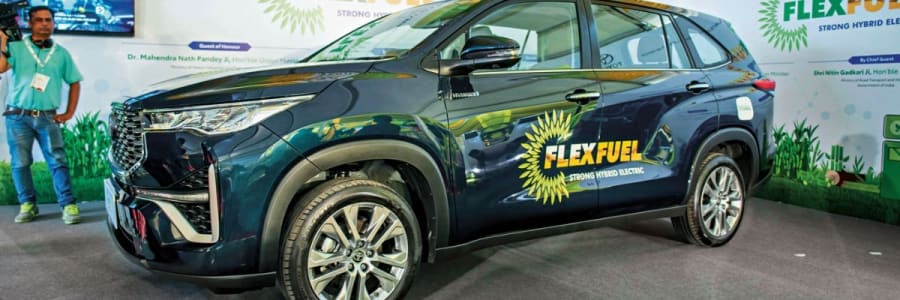
Estimates suggest a 3-5% premium over standard variants due to ethanol-resistant fuel lines, upgraded injectors, and corrosion-proof tanks. [Toyota's flex-fuel Innova HyCross] was priced slightly above the standard model. As volumes scale, the premium should shrink.
How does ethanol pricing compare to petrol?
Ethanol is typically 20-30% cheaper per litre than petrol at wholesale. But lower energy density partly offsets savings. In [Brazil, where flex-fuel is mainstream], drivers use a simple rule: buy ethanol only if it costs less than 70% of petrol price. Indian pricing will depend on govt-set ethanol procurement rates.
What happens in regions with low E20 supply?
Flex-fuel vehicles handle this gracefully. They run on any blend from pure petrol to high ethanol. So in [rural areas with limited E20 pumps], drivers simply fill regular petrol. The ECU adjusts automatically. No performance penalty. The vehicle is future-proofed as ethanol infrastructure expands.
Which automakers are leading the push?
Maruti Suzuki, Toyota, and Hyundai are among the first movers. [Toyota launched a flex-fuel Innova HyCross pilot in India in 2023]. Maruti has tested flex-fuel versions of the Wagon R. With India being the world's 3rd largest ethanol producer, OEMs see regulatory alignment and raw material supply as strong tailwinds.
Which companies lead global flex-fuel tech?
Global leaders include [GM, Ford, and Volkswagen], all with decades of flex-fuel experience in Brazil. Toyota has pushed the tech in Asia. Indian OEMs are licensing or co-developing with these players rather than building from scratch, which shortens time-to-market.
How big is India's ethanol production?
India produces ~4.8Bn litres of ethanol annually, making it the 3rd largest producer globally after the US and Brazil. Most comes from [sugarcane molasses in UP and Maharashtra]. The govt targets 20% blending by 2025-26, which requires ~10Bn litres, so production capacity must roughly double.
Why did Brazil succeed with flex-fuel?
Brazil mandated ethanol blending in the 1970s during the oil crisis. By 2003, [Volkswagen launched the first mass-market flex-fuel car there]. Today, ~80% of new cars sold in Brazil are flex-fuel. Key enablers: abundant sugarcane, govt tax incentives for ethanol, and dense distribution infrastructure at fuel stations.
Source: businesstoday.in