world · 2026-11-23
Why does one tanker strike in Hormuz shake oil prices?
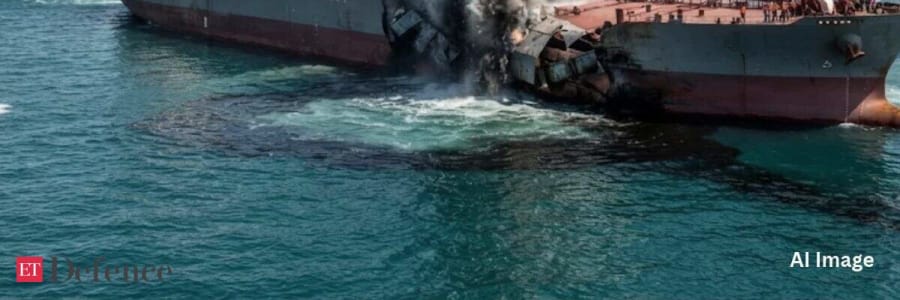
Photo: via The Economic Times
Iran said a tanker hit a mine in the Strait of Hormuz, a key oil route. With global oil flows already down, any threat there can spike prices worldwide.
Did the tanker actually hit a mine?
No one can confirm it. Iran's navy said the tanker hit a naval mine in a restricted area east of the Strait of Hormuz, a claim Reuters, the news agency, could not independently verify. Separately, the UK Maritime Trade Operations, a British agency tracking shipping threats, reported two tankers hit by unidentified projectiles off Oman. Whether those involve the same vessel is unclear, and the weapon type remains undetermined.
Is there independent evidence the tanker hit a mine?
No. The only account is Iran's navy, which said a tanker hit a mine. Reuters could not verify it, and UKMTO reported projectiles, not mines. Also, the US military had claimed all mines were cleared from the strait, which casts doubt on the mine explanation.
Was Iran's mine-hit tanker the same as UKMTO's incidents?
No link is established. UKMTO reported two tankers hit by projectiles near Khasab, but it was unclear if they were the same vessel. Iran separately claimed a tanker hit a mine east of Hormuz. Reuters and Al Jazeera said the Iranian account could not be verified or tied to either UKMTO report. The reports stand as separate accounts.
What did independent monitors say happened?
Independent monitors could not confirm Iran's mine claim. The UK Maritime Trade Operations, a British agency tracking shipping threats, reported two tanker hits that day by "unidentified projectile": one on its stern 11 nautical miles north of Oman's Khasab, another in its engine room 17 nautical miles east of Khasab. It did not identify the weapon or say if the same vessel was involved.
How does Iran's mine claim compare with projectile reports?
Iran says tankers caught fire from naval mines, but UKMTO described the same day's hits as "unidentified projectile" strikes, one 11 nautical miles north of Khasab and another 17 nautical miles east of it. Whether Iran's mine-hit vessel matches either is unconfirmed. US officials said mines were cleared, and Iran has a pattern of claiming mines in recent weeks, per Al Jazeera and Reuters.
Is there any independent proof mines were used?
No. The Joint Maritime Information Center logged attacks as "unidentified projectile," and the IMO's 136 confirmed regional incidents as of November 11 are not mine counts. US Defense Secretary Pete Hegseth said in March there was no clear evidence of mines. Iran has 5,000-6,000 mines in stock, but no public report confirms their use.
What would confirm a mine strike?
Determining a mine caused damage needs technical evidence: damage analysis, recovered components, underwater investigation, and reliable vessel position. Public reporting on November incidents lacks that. A legal analysis says explosions alone cannot establish the mechanism. Without such evidence, a mine strike remains unproven, though Iran's mine stock and past claims keep it possible.
Why does Iran claim mines while others say projectiles?
Iran claims mines because it has been asserting control over the Strait of Hormuz, attacking ships it says violate its restrictions. Maritime monitors like UKMTO, the British agency tracking shipping threats, use "unidentified projectile" because they cannot confirm the weapon, it could be a mine, missile or drone. Independent reports often don't verify Iran's mine claims.
Have any independent investigations identified the attackers?
No independent investigation has publicly named the attackers. UKMTO and JMIC recorded incidents but called the weapon an 'unidentified projectile' and did not attribute them. Iran's mine claims were unverified. One ship, SEA 1, was struck by a UAV per UKMTO, but no group claimed responsibility. Another, NCC Fajr, was a 'possible attack' per Vanguard Tech, with details unconfirmed.
Source: economictimes.indiatimes.com