economy · 2026-07-11
Why E20 Petrol Costs More Despite Ethanol
f64dac2d-8e19-4871-b50f-12025d092b95
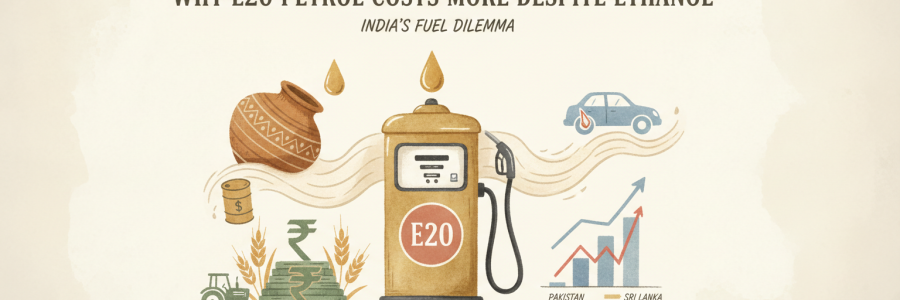
India completed nationwide E20 rollout, but the govt confirms blended petrol costs more to produce than pure petrol at current crude prices of ~$70/barrel.E20 is not meant to cut prices. It cushions against crude spikes. Petrol prices in Delhi rose only 5.6% over four years, far less than Pakistan or Sri Lanka.Farmers earn ₹1.66L Cr from ethanol sales. Vehicle owners pay roughly the same pump price but get ~6-7% lower mileage per litre due to ethanol's lower energy density.
How does fixed ethanol pricing make E20 costlier?
The govt buys maize-based ethanol at a fixed ~₹71.86/litre before GST, transport, and storage. Crude oil at $70/barrel produces petrol cheaper than this. Unlike crude, ethanol prices don't fluctuate, they're set to guarantee farmer income. So blending a costlier ingredient into cheaper petrol raises production cost, not lowers it.
Why doesn't the govt let ethanol prices float?
Fixed pricing is deliberate. The govt guarantees purchase prices so farmers and distillers invest in capacity without fearing price crashes. India has financed ~₹1L Cr in ethanol production infrastructure through public sector banks. If prices floated, a crude crash could make ethanol uneconomical overnight, stranding these investments and cutting farmer income.
How much does transport and storage add to cost?
The ₹71.86/litre is just the base procurement price. GST, transportation from distillery to oil depot, storage, and handling charges add further cost. India has ~350+ ethanol distilleries spread across states like UP, Maharashtra, and Karnataka. Moving ethanol to blending depots nationwide adds logistics costs that pure petrol, refined at coastal refineries near ports, avoids.
Could sugarcane ethanol be cheaper than maize?
Sugarcane-based ethanol historically costs more, not less. The govt prices it at ₹65-66/litre for C-heavy molasses but up to ₹68 for B-heavy and higher for direct juice. Maize became the preferred new feedstock precisely because it avoids diverting sugar supply. The real cost driver is India's structural decision to price all feedstocks above market to support farmers.
At what crude price does E20 become cheaper?
The ministry says E20 becomes cheaper to produce when crude hits $120-130/barrel. At that level, ethanol's fixed ₹71.86/litre undercuts the refining cost of pure petrol. For context, crude last touched $120 in mid-2022 during the Russia-Ukraine war. At current $70, ethanol is the more expensive component by a wide margin.
Would E20 savings show up if crude spikes again?
Yes, clearly. At $120/barrel crude, India's 20% ethanol buffer means 20% of every litre is sourced domestically at a fixed ₹71.86, insulating that portion from the spike. During the 2022 crude surge, India's ethanol blending was only ~10%. At 20%, the cushion roughly doubles. The ministry frames E20 as insurance, not discount.
How do Pakistan and Sri Lanka compare on prices?
Delhi petrol prices rose 5.6% between Jun 2022 and Jun 2026. Pakistan's petrol prices surged over 60% in the same period amid IMF-mandated subsidy cuts. Sri Lanka saw even steeper hikes during its 2022 forex crisis. India's combination of ethanol blending, excise tax adjustments, and oil marketing company margin absorption kept prices flatter.
Has any country made flex-fuel pricing work?
Brazil is the model. Drivers there follow a simple rule: buy ethanol only if it costs less than 70% of petrol's price, since ethanol has lower energy. Flex-fuel cars let consumers switch in real time. India lacks flex-fuel vehicles at scale. Without that choice, Indian drivers cannot arbitrage between fuels, they simply receive E20 with no opt-out.
Who bears the hidden cost of lower mileage?
Vehicle owners absorb it silently. Ethanol has ~30% less energy per litre than petrol, so E20 delivers roughly 6-7% lower fuel efficiency. A car getting 15 km/l on pure petrol might drop to ~14 km/l on E20. That means more frequent fill-ups. Meanwhile, premium petrol demand at Delhi stations has doubled as some consumers seek alternatives.
Why can't vehicle owners choose pure petrol?
The govt mandates E20 nationwide. No pump offers pure petrol as an option. The ministry argues opt-outs would fragment supply chains and raise costs. Interestingly, premium petrol demand at Delhi stations has doubled, suggesting consumers are seeking higher-octane fuel to offset perceived E20 performance drops. But even premium grades now contain ethanol.
Does lower mileage wipe out the forex savings?
Not entirely, but it narrows the gain. The govt claims ₹1.97L Cr in forex savings from reduced crude imports. However, if 20 Cr car owners each burn 6-7% more fuel annually, that adds roughly 5-6% more volume consumed. The net forex saving is real but smaller than the headline number suggests. The ministry's figure does not adjust for this efficiency loss.
Could EV adoption undercut the ethanol program?
Yes, in the long run. India targets 30% EV penetration for new car sales by 2030. Every EV sold reduces petrol demand, shrinking the base over which ethanol blending costs are spread. If petrol demand peaks by 2030, the ₹1L Cr in distillery investments financed by PSBs face a stranded-asset risk. The govt may need to pivot ethanol toward aviation fuel or chemicals.
Source: businesstoday.in