economy · 2026-07-09
Why LNG and LPG Face More Hormuz Risk
62c7c713-d24c-4e47-b19f-cf7c6abf9710
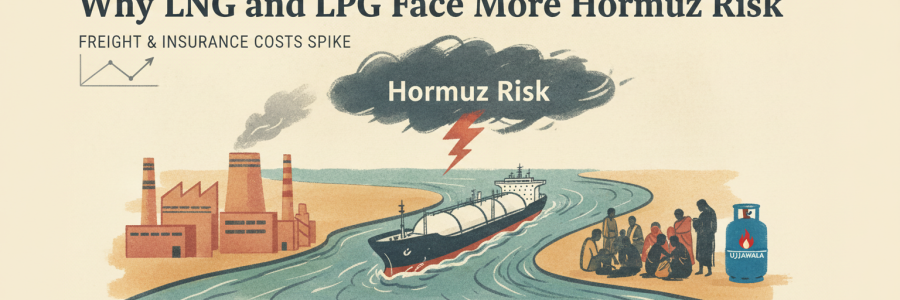
US-Iran ceasefire collapsed, reviving Strait of Hormuz transit fears. Freight and insurance costs may spike, but India's crude supply stays diversified enough to cope.LNG and LPG have fewer short-term substitutes than crude, making them far more vulnerable to Gulf shipping disruptions. Prolonged instability could tighten supply and raise regional prices.Indian refiners, LPG-dependent households (~300Mn connections via Ujjwala and commercial), and gas-importing power/fertilizer plants face the sharpest exposure.
What makes LNG and LPG harder to reroute?
Crude can be sourced from dozens of global suppliers. Russia, West Africa, and Latin America now anchor India's import basket, reducing Hormuz dependence. LNG and LPG, by contrast, rely heavily on Qatar and UAE, both shipping through Hormuz. Kpler analyst Sumit Ritolia notes these fuels have fewer short-term substitution options, so a single chokepoint disruption bites harder.
Why can't LNG just come from non-Gulf sources?
Global LNG is sold mostly under long-term contracts tied to specific liquefaction terminals. Qatar alone supplies ~20% of global LNG. Alternatives like US Gulf Coast or Australia's North West Shelf exist but are already near full capacity. Redirecting cargoes requires months of logistical planning, unlike crude, where a single tanker can switch loading ports relatively quickly.
How do bypass pipelines skip Hormuz exactly?
Saudi Arabia's East-West Pipeline can move ~5Mn barrels/day from eastern oilfields to the Red Sea port of Yanbu, completely bypassing Hormuz. The UAE's Habshan-Fujairah pipeline similarly connects Abu Dhabi fields to Fujairah on the Indian Ocean coast. These give India's top Gulf crude suppliers a physical workaround that LNG terminals lack.
What share of India's LPG comes via Hormuz?
India imports ~60% of its LPG, and the Gulf accounts for roughly half of those imports. Qatar, Saudi Arabia, and the UAE are the primary suppliers, all routing through Hormuz. Domestically, ONGC and Oil India produce some LPG as a refinery byproduct, but output covers only ~40% of demand. Any sustained Hormuz disruption directly squeezes cooking fuel availability.
Could India's crude diversification break down?
India's crude basket is more diversified than a few years ago. Russian crude alone now accounts for a significant share. Saudi and UAE barrels also move via bypass pipelines that skip Hormuz entirely. But if tensions persist beyond a few months, rising freight and insurance costs could erode the cost advantage of distant suppliers like Brazil or Guyana, pressuring refining margins.
How much would crude freight rates need to rise?
Freight rates on the Middle East-to-India route (TD3C benchmark) have already risen ~15-20% since tensions escalated. Analysts estimate a further doubling of war-risk insurance premiums, currently ~0.5% of hull value per transit, could add $1-2 per barrel to delivered costs. Indian refiners like Reliance and BPCL absorb this until margins compress below their $5-7/barrel processing spread.
Is Iranian crude truly off the table for India?
Technically, India stopped buying Iranian crude in 2019 after US sanctions tightened. Kpler's Ritolia notes that compliance risk, not physical availability, is the barrier. Refiners like MRPL, which once processed Iranian heavy crude, face secondary sanctions on banking and insurance if they resume purchases. Until a formal sanctions waiver exists, Iranian barrels remain commercially untouchable.
What triggers a refiner margin squeeze exactly?
Refiners earn the spread between crude input cost and product selling price. When freight and insurance add $1-2/barrel, and when crack spreads for diesel or petrol are only $5-7/barrel, that extra cost eats 15-30% of the margin. Indian public-sector refiners like BPCL and HPCL, which cannot freely raise pump prices, are more exposed than Reliance, which sells at market rates.
Which industries beyond refiners face the hit?
LPG-dependent households are most exposed. India has ~300Mn LPG connections. Fertilizer plants that use imported LNG as feedstock, like IFFCO's Phulpur unit, face input cost spikes. City gas distributors such as IGL and Mahanagar Gas could see compressed margins if spot LNG prices surge, potentially passing costs to CNG and piped-gas customers.
Who absorbs LPG cost spikes, govt or consumer?
The govt currently subsidizes ~₹200 per LPG cylinder for Ujjwala beneficiaries. If import costs spike, the oil marketing companies, IOC, BPCL, HPCL, initially absorb the increase. If it persists beyond a quarter, the govt faces a choice: raise the subsidy bill or let retail prices rise for non-subsidized ~200Mn commercial and urban connections.
How quickly could fertilizer plants switch fuel?
Most Indian fertilizer plants, like IFFCO Phulpur or Chambal Fertilisers, run on gas-specific Haber-Bosch process equipment. Switching to naphtha or fuel oil requires physical retrofitting that takes 6-12 months and costs hundreds of crores. In practice, plants either pay the higher spot LNG price or cut output, as IFFCO briefly did during the 2022 European gas spike.
Does city gas have any buffer stock mechanism?
India has no strategic LNG reserve equivalent to crude's strategic petroleum reserve. City gas companies like IGL maintain roughly 2-3 days of pipeline linepack, a thin buffer. If spot LNG cargoes are delayed even a week, distributors must curtail industrial supply first to protect household piped-gas connections, exactly as Mahanagar Gas did during a 2023 spot shortage.
Source: businesstoday.in