world · 2026-07-10
Why the US-Iran Hormuz Truce Is Failing
d1180713-8013-45f8-9efa-80d73a2b26ef
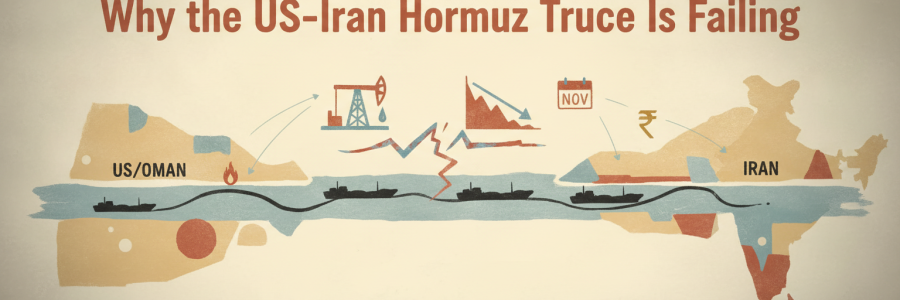
US and Iran are in their most severe clashes since the ceasefire, after a June 25 attack on a Singapore-flagged vessel off Oman triggered tit-for-tat strikes.The US revoked Iranian oil sanctions waivers this week. With US oil reserves running low and midterms in Nov, both sides face pressure to de-escalate.India imports ~60% of its crude via Hormuz. Escalation threatens Indian refiners, shipping insurers, and pump prices for 140Cr consumers.
What triggered this specific escalation cycle?
A Singapore-flagged commercial vessel was attacked off Oman's coast on Jun 25. The US responded with strikes on southern Iran. Iran then hit bases hosting US troops in Gulf states. This week the US also revoked sanctions waivers on Iranian oil granted under the ceasefire, intensifying the cycle significantly.
Why was the ceasefire deal structurally weak?
Analyst Negar Mortazavi described the MoU as a framework for managing conflict, not a comprehensive peace deal. It left core disputes unresolved, including Iran's nuclear program and regional proxy operations. Both sides are now testing its boundaries, interpreting ambiguous terms in their favor. Comparable to the 2015 JCPOA, which also deferred key issues.
Who attacked the Singapore-flagged vessel?
Attribution remains contested. The Jun 25 attack off Oman's coast targeted a commercial vessel. In past Hormuz incidents, Iran-aligned groups or IRGC naval forces were implicated. The US treated it as sufficient provocation to strike southern Iran directly, suggesting intelligence pointed to Iranian involvement, though no formal public attribution was detailed in reporting.
What sanctions waivers were revoked this week?
Under the ceasefire, the US had granted waivers allowing limited Iranian oil exports, roughly 500K-800K barrels/day to buyers like China. Revoking these waivers cuts Iran's main revenue stream and re-tightens the sanctions regime. For context, Iran's total oil revenue under waivers was ~$30Bn/year. The revocation is both economic punishment and negotiating leverage.
Could both sides still pull back from war?
Both sides have domestic brakes. Iran faces runaway inflation and risks of protests like the Jan uprising. The US is running low on Strategic Petroleum Reserve oil that buffered pump prices during the war, and Nov midterms loom. Analyst Ryan Costello notes these pressures create strategic reasons to de-escalate, though the ceasefire's design flaws persist.
How low are US oil reserves right now?
The US Strategic Petroleum Reserve stood at ~350Mn barrels before the war but has been drawn down to buffer pump prices. Current levels are estimated near 300Mn barrels, about half the 2010 peak of ~727Mn. At drawdown rates of 1Mn barrels/day, the cushion lasts months, not years, limiting Washington's ability to shield consumers from price spikes.
What happens if violence lasts past Nov midterms?
If clashes persist into Nov, the party in power risks voter backlash over $4-5/gallon gasoline. In 2022 midterms, inflation and gas prices heavily shaped outcomes. Congress could force constraints on military operations via war powers resolutions. The administration needs either a credible de-escalation or lower oil prices to avoid electoral damage.
Is this becoming Trump's 'forever war'?
Costello used the 'forever war' framing explicitly. The pattern echoes Afghanistan and Iraq, where initial strikes proved far easier than exit. The US lacks a clear end-state: regime change is off the table, Iran won't abandon its nuclear ambitions, and proxy networks across Iraq, Yemen, and Lebanon remain active. Each escalation cycle resets rather than resolves the conflict.
How does this hit Indian fuel costs directly?
India routes ~60% of its crude imports through Hormuz, roughly 9 in 10 of which head to Asian buyers. Indian refiners like Reliance's Jamnagar and BPCL face rising cargo insurance premiums and potential supply disruptions. If sustained, crude prices could push India's import bill up by ₹50K-80K Cr annually, pressuring pump prices and the current account deficit.
Which Indian refiners are most exposed?
Reliance Jamnagar, the world's largest refining complex at 1.4Mn barrels/day capacity, sources significant crude from Iraq and Saudi Arabia via Hormuz. BPCL's Kochi refinery imports Middle Eastern grades almost exclusively. These refineries run continuously. They cannot simply switch off. A 2-week supply disruption would force costly spot purchases at $5-10/barrel premiums.
How do shipping insurance costs change here?
War-risk insurance premiums for Hormuz-transiting tankers jumped 3-5x during the 2024 conflict phase. A standard VLCC voyage from Basra to Jamnagar costs ~$500K in insurance normally. During active hostilities, premiums can spike to $2-3Mn per voyage. Indian Oil Corporation and Shipping Corporation of India absorb these costs initially, but they pass through to fuel prices within weeks.
Could India switch away from Hormuz routes?
Alternative routes add significant cost. Routing around Hormuz via the Cape of Good Hope adds ~15 days and $3-4Mn per VLCC voyage. India has diversified toward Russian Urals crude since 2022, which avoids Hormuz entirely, now ~35% of imports. But Middle Eastern grades remain essential for Indian refinery configurations, which are optimized for Arab Light and similar blends.
Source: aljazeera.com